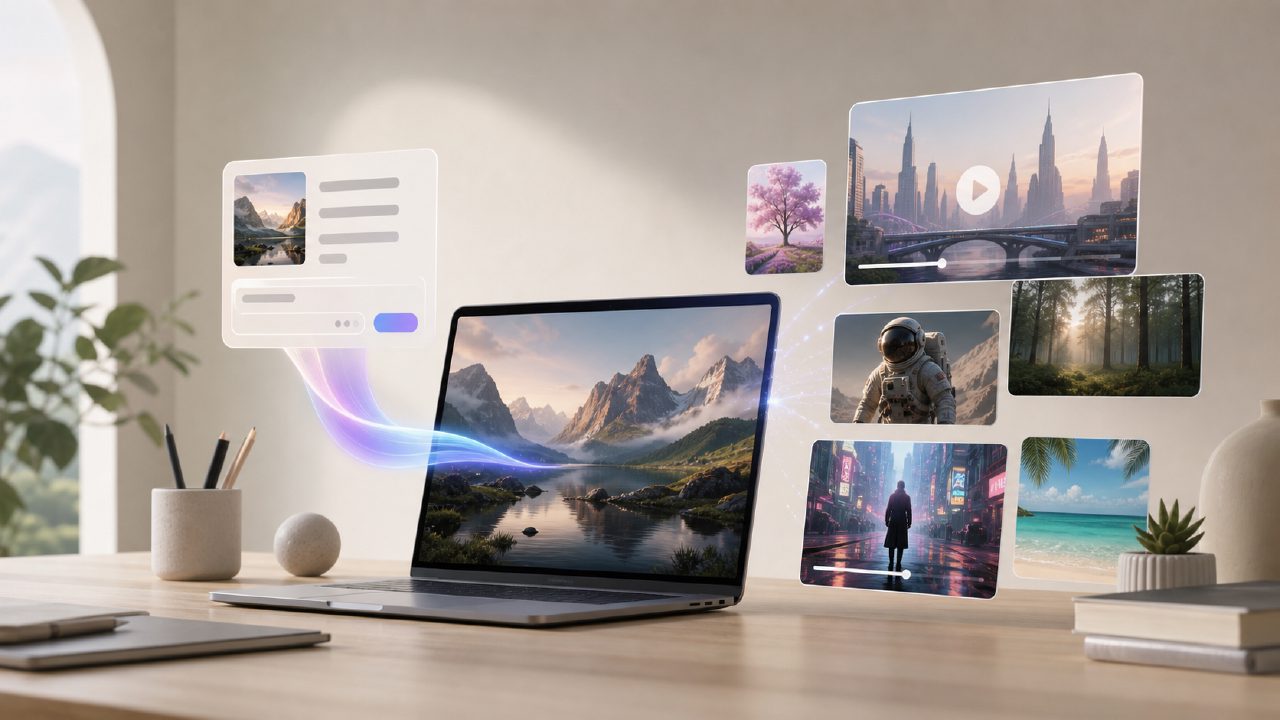
What makes Vizly the best AI tool to generate images and videos from text?
I’ve been testing Vizly for a couple of weeks now, and I can see why people keep calling it the best ai tool to generate images and videos from text — at least for certain kinds of work. The key difference I noticed immediately is that it doesn’t force you into a separate tool for video. You write one prompt, and it offers both stills and motion outputs in the same workflow. That alone saved me a lot of tab-switching.
What surprised me most was the consistency. I gave it a prompt like “a neon-lit cyberpunk street market at night,” and the image came back with surprisingly coherent lighting and reflections. The video version of that same scene took about 90 seconds and looked more like a stylized animation than a cheap morph. Not every frame is perfect — there’s some warping around edges — but for quick concept visuals or social content, it’s very usable.
The free tier is generous enough that you can actually evaluate it before paying. More on that below.
Is Vizly really an ai image generator free unlimited option?
No — but it’s close enough that “free unlimited” isn’t a total lie. You get a daily refresh of credits (I got about 15 image generations and 3 short video clips per day on the free plan). That resets every 12 hours, so if you time it right, you can generate dozens of outputs in a day without paying. It’s not truly unlimited, but for most casual users or small businesses testing ideas, it feels unlimited enough.
The catch: video exports on the free plan are watermarked and capped at 720p. That’s a real tradeoff if you need clean quality. But for internal drafts or quick mockups, the motion quality is decent. I used it to generate a few animated backgrounds for a presentation, and the watermark was small enough to live with.
If you push it hard in one session, it might tell you to wait an hour before more free credits. That happened to me twice. Mild friction, but not a dealbreaker.
How does Vizly compare to other best free ai image generator 2026 options out there?
I tested three other top contenders: Midjourney (still subscription-only), DALL-E 3 (pay-per-use), and a newer free tool called Pixaura. Vizly stands apart because it combines image and video in one place — none of those three do that without extra steps. For pure still images, DALL-E 3 is slightly better at photorealism, but Vizly handles more stylized prompts better, especially fantasy and sci-fi.
Another edge: Vizly’s negative prompt field is actually useful. I typed “no blur, no cartoon” and got sharper results than expected. That kind of control is rare in free-tier tools. The one area where Vizly falls behind is speed for video — a 10-second clip took almost three minutes during peak hours. Still, it’s consistent, which matters more.
If you’re looking for the best free ai image generator 2026 that also does video, Vizly is probably your best bet right now. If you only need stills and have money, Midjourney is still king.
How good is Vizly as a best ai text to video tool 2026 contender?
I’m cautious here because video AI is still a mess. Vizly does two things well: text animation and scene transitions. I gave it “a waterfall in a jungle, slow pan down” and it returned a clip that actually moved the camera downward — something many tools fail at. But motion physics are hit or miss. Water looked good; leaves on a tree didn’t move naturally and looked slightly jittery.
The tool’s strongest use for video is in short-form content: Instagram stories, TikTok intros, visual moodboards. I wouldn’t use it for narrative video or anything requiring lip-sync or characters walking. It also doesn’t support audio input yet, so you can’t generate lip movements from speech. That’s a clear limitation.
Still, for a free-tier option, it’s miles ahead of what I saw last year. If you need a best ai text to video tool 2026 that doesn’t cost a subscription, Vizly is worth testing — but keep expectations measured.
What are Vizly’s main drawbacks and tradeoffs?
A few things bugged me. First, the prompt accuracy for complex scenes with multiple objects is inconsistent. I asked for “a dog wearing a hat sitting next to a coffee cup” and got a dog with a hat but no cup. Regenerating with the same prompt gave me a cup but the hat disappeared. It’s not great at following very specific layouts.
Second, the video output is limited to 10 seconds on the free plan. That’s fine for loops, but if you need longer clips, you need paid credits. The pricing is reasonable ($10/month for 100 credits, each credit = one video generation), but it adds up fast if you’re making many variants.
Third, the interface is clean but some buttons are oddly placed. The “extend video” function is buried under a second menu, and I missed it the first three times. Minor UX friction, but worth mentioning.
Overall, Vizly is a genuinely useful tool with real tradeoffs. It’s the best all-in-one free option for image + video generation right now, but it’s not a replacement for dedicated tools if you have specific quality needs. Test the free tier before committing.
Comments
Leave a Comment