Finding the right vintage visual often feels like digging through a dusty attic. Stock photo sites give you sterile, over-lit retro filters that look like a modern smartphone just slapped a sepia preset on a staged model. Actual historical archives are either low resolution, heavily damaged, or locked behind expensive licensing. You want that authentic 1920s Art Deco poster vibe or a crisp Victorian botanical sketch, but sourcing it without spending days in Photoshop is a real bottleneck. That’s exactly where Vizly Image Studio steps in—it lets you synthesize those old-school aesthetics directly from a text prompt.
Prompting for Specific Eras with Vizly Image Studio
Generating convincing vintage imagery isn't just about adding "old" or "retro" to your prompt. The trick is naming the specific medium, camera, or art movement. Vizly responds well to these constraints. If you want a 1970s Polaroid look, specifying "Kodak Instamatic flash, washed out colors, blurred edges" gives you that specific cheap-film aesthetic rather than a generic vintage blur. For something earlier, asking for "copperplate engraving, 18th-century botanical illustration, hand-tinted watercolor" produces a completely different texture that actually mimics the ink and paper of that era.
The generator handles texture surprisingly well. I’ve run prompts for mid-century modern travel posters, and the output consistently captures that slightly grainy, off-register print look you see in actual lithographs. It doesn't just draw a modern graphic and age it; it seems to build the texture into the composition from the start.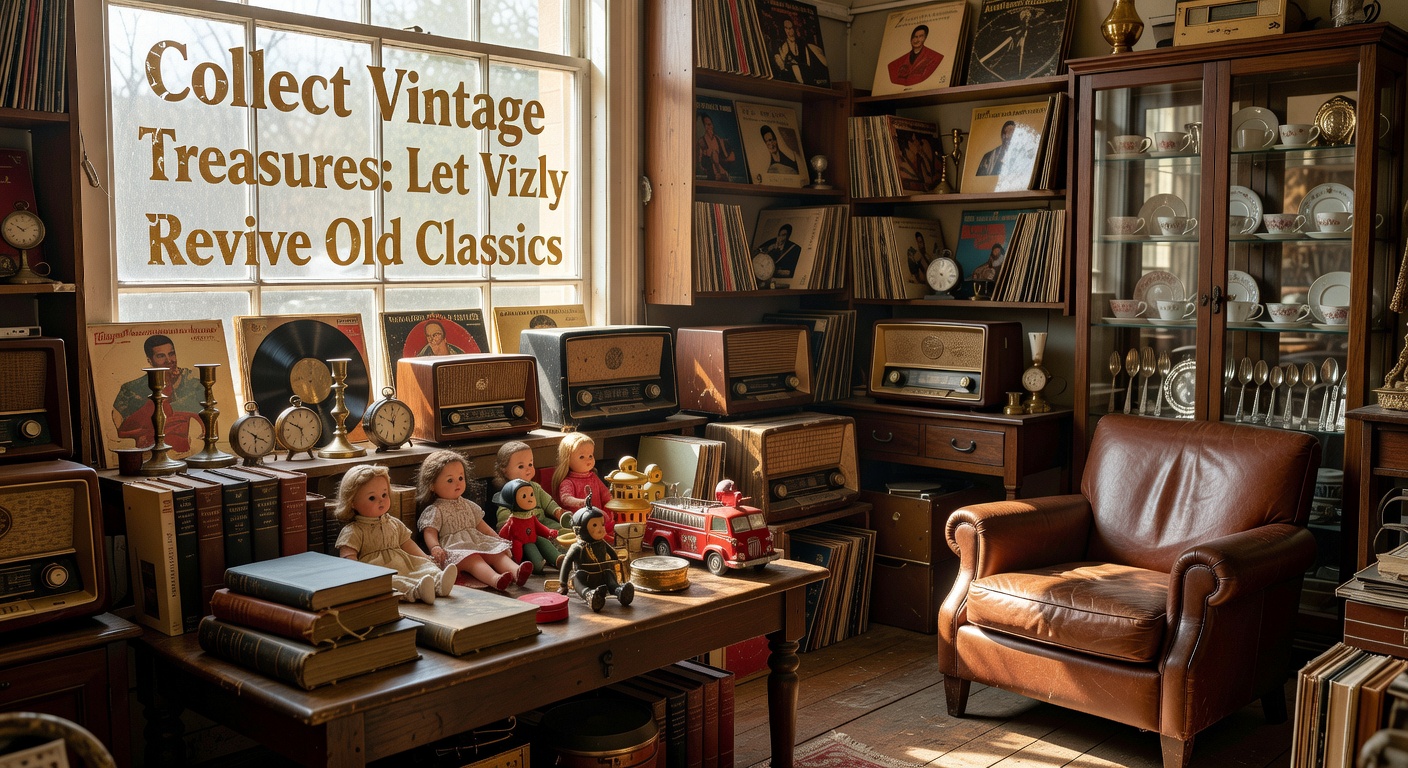
Concrete Scenarios for Reviving Classics
Where does this actually fit into a workflow? A few situations come up constantly.
First, packaging design. A craft brewery or artisan coffee roaster often leans into heritage aesthetics. Instead of licensing a random 19th-century etching that doesn't match the brand's specific mascot or locale, you can generate a bespoke Victorian trade card that features your exact elements but keeps the authentic line-work and typography style of the era.
Second, editorial and zine work. If you're writing a piece about a fictional 1930s detective, you need period-appropriate portraits. You can prompt Vizly for "1930s press photography, flashbulb lighting, grainy black and white" to create character portraits that feel like they were pulled from an actual newspaper archive, bypassing the uncanny valley of dressing up modern models in old hats.
Third, concept restoration. Sometimes you have a terrible scan of a beautiful old poster, but it’s too damaged to use. You can use Vizly to generate a "clean" version of that style, effectively recreating the vibe of the damaged original without the painstaking digital restoration work.
The Tradeoffs: Aesthetic vs. Authenticity
There is a hard limit you have to accept with AI vintage generation: it is aesthetic simulation, not historical documentation. Vizly will give you a picture that looks 1890s, but it won't pass scrutiny for actual historical accuracy. The generator frequently fudges period-specific clothing details, architectural proportions, or old-school typography. It might put a 1950s collar on an 1890s dress, or render a vintage sign with a modern sans-serif font disguised as a woodblock print.
If you are a museum curator or an academic publisher needing exact historical fidelity, this tool won't replace archival research. The artifacts it creates are convincing at a glance, but they are ultimately pastiches. You still need a sharp eye to catch anachronisms in the output before using it in a final project.
For alternatives, if you need absolute authenticity, you still have to dig through physical archives or public domain databases like the Library of Congress. If you just need to apply a convincing aging filter to an existing photo, a dedicated tool like Photoshop or a film-emulation app might be faster. Vizly Image Studio occupies the middle ground: it is best when you need an entirely new image that possesses the soul and texture of an old classic, but doesn't need to survive a historian's fact-check.
Wrapping Up
Using Vizly Image Studio to collect vintage treasures is less about archiving the past and more about remixing it. It solves the specific problem of getting high-resolution, period-flavored visuals without the licensing fees or resolution limits of real archives. You just have to be precise with your prompts and ruthless about catching anachronisms in the details. It’s a fast, practical way to revive classic aesthetics for modern work, as long as you treat it as a creative tool, not a time machine.
Comments
Leave a Comment