You've spent hours tracking down a faded passage in a 17th-century herbary, and the only thing more fragmentary than the Latin text is the crumbling woodcut that accompanies it. You want to see what that plant actually looked like—not as a flattened, ink-smudged ghost, but as a living form with color and depth. That impulse, to pull something lost back into visible presence, is exactly where AI image generation starts doing real work for old collections.
From Fragment to Visual Hypothesis
Vizly Image Studio sits in that specific niche between textual description and visual reconstruction. You feed it a prompt—say, "a dense folio page from a 15th-century illuminated manuscript, gold leaf borders, vinestock margins, deep burgundy ink on vellum"—and within minutes you get something that looks plausible enough to make you pause. It won't pass scholarly peer review, but it gives you a concrete image to react to, refine, or reject. That reaction is the useful part. Seeing a generated version of a described scene forces you to articulate what's wrong with it, and that articulation often sharpens your actual reading of the source text.
Consider a more grounded scenario. A rare book dealer is building a listing for a damaged codex. The binding is gone, half the pages are water-stained, and the remaining illustrations are barely legible. Instead of photographing decay, they prompt Vizly to reconstruct a clean version of one signature based on the visible fragments and a written description from an 1890s catalog. The result isn't archival truth—it's a visual hypothesis. But it's a hypothesis that makes the listing readable, that lets a potential buyer see what the object might have been before time ate it. That functional shift, from documenting loss to projecting possibility, changes how these objects circulate in the market and in imagination.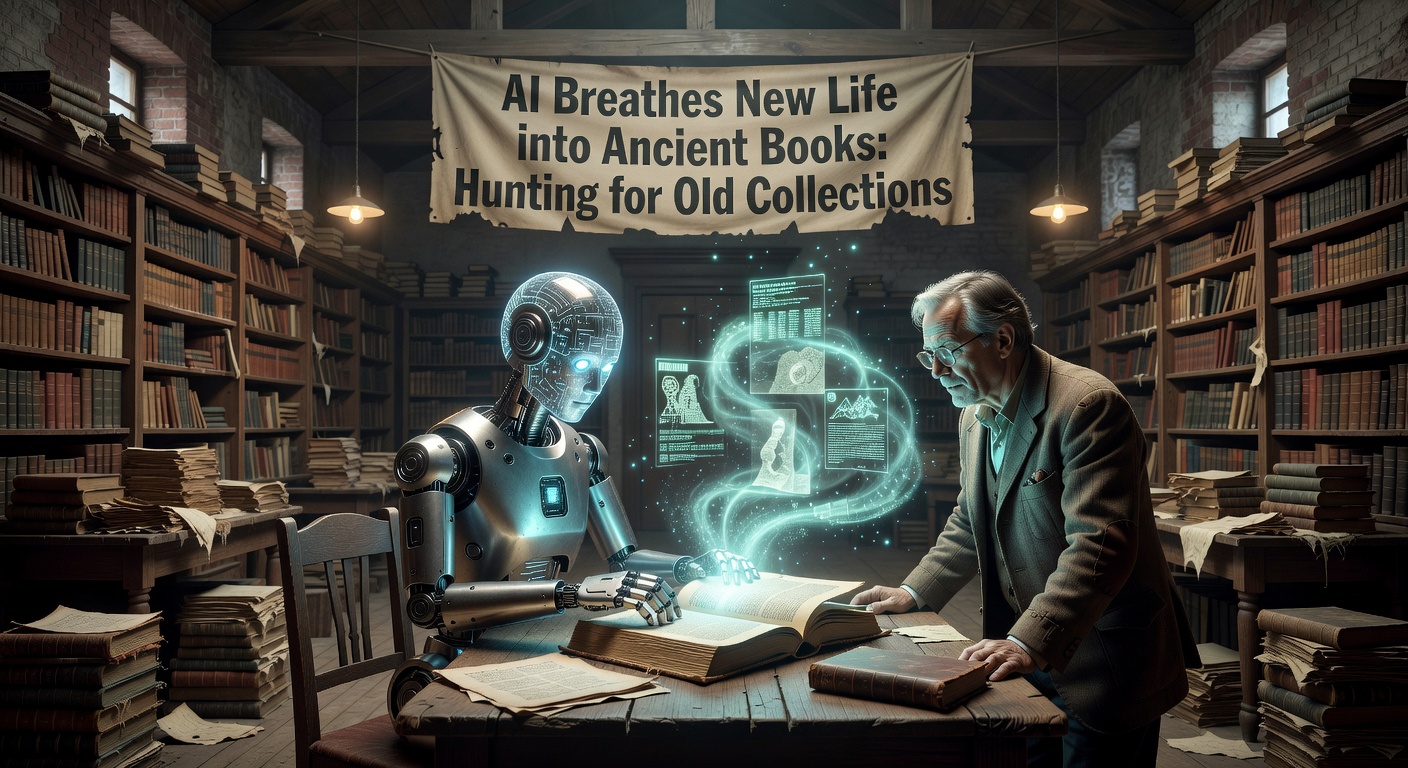
Where the Tool Bends and Where It Breaks
The tradeoffs are real. Vizly, like any current image generator, handles stylistic prompts reasonably well—"Mughal miniature palette," "Kufic border script," "Gothic initial letter rubrication"—but it doesn't understand structural logic. An illuminated manuscript page isn't just a pretty pattern; the border program reflects the liturgical calendar, the hierarchy of scripts encodes textual priority. The AI will give you a decorative layout that looks right at first glance but violates the internal rules that a real codex obeys. That's fine for mood-setting or social media content. It's dangerous if you're trying to argue that a specific manuscript tradition worked in a specific way.
There's also a flattening problem. Run the same prompt twenty times and you'll get twenty variations, but they'll cluster around a visual mean. The outliers get trimmed by the model's own consistency logic. Old book aesthetics, though, are defined by their inconsistencies—the scribe who switched pigments mid-page, the binder who reused a older cover, the marginalia that argues with the main text. AI tends to smooth those bumps out, producing a kind of idealized antiquity that never actually existed.
Practical Scenarios and Limits
Three use cases where Vizly actually earns its place in an old-book workflow:
First, content creation for collection outreach. A small library wants Instagram material for a newly acquired incunabulum. Photographs of the actual object are underlit and visually dull. Generated images based on the text's own descriptions—stylized, vivid, clearly labeled as interpretations—draw attention without misleading viewers about what the physical item looks like.
Second, design prototyping. A publisher is reissuing a translated medieval bestiary and needs cover concepts. Instead of commissioning speculative art before the editorial direction is locked, the design team generates a dozen prompt-based variations in an afternoon. Two of them survive into the final brief. The rest were cheap failures, which is exactly what prototyping should allow.
Third, pedagogical visualization. A lecturer on early cartography wants students to feel the conceptual gap between a Ptolemaic map and a portolan chart. Generating both styles from descriptive prompts makes that gap visible in a single slide deck, faster than hunting down high-resolution reproductions that may have restrictive rights.
Judging Fit: When to Use It and When to Walk Away
Vizly is a sketch tool, not a forensic instrument. If your goal is to produce imagery that supports a scholarly argument about what a specific historical object looked like, you need to stop at the prompt stage and go find actual reproductions. The AI's output is interpretive fiction, and presenting it as anything else is a credibility error.
But if you need to make old texts feel present rather than distant—to give a modern reader a foothold in alien visual grammar—then generated imagery does something real photographs often can't. It fills the gap between what's legible and what's visible with something structured enough to be useful and speculative enough to be honest. The tool works best when you treat it as a collaborator with bad archival instincts and good aesthetic reflexes: you provide the constraints, it provides the speed, and you remain the one who decides what counts as a plausible version of the past.
Comments
Leave a Comment