You type "neon wolf in a cyberpunk alley with rain reflecting on wet pavement," wait two seconds, and there it is—not a blurry mess, not a creature with three legs, but something that actually looks like a still from a movie you’d want to watch. That’s the first thing most people notice about Vizly. It’s fast, it understands messy prompts, and it doesn’t force you into a filter catalog. The real question is: does that matter when there are already a dozen image generators out there?
Where Vizly stands out: not just speed, but taste
Speed is table stakes now. Every AI image tool can spit out four variations in under ten seconds. What makes Vizly different is the way it handles composition and lighting without you having to specify every technical detail. I threw in a prompt like “a frustrated designer sitting in front of a MacBook, messy desk, late night vibe, cinematic lighting.” Other tools gave me a cartoon or something that looked like a stock photo from 2015. Vizly gave me an image that looked like a still from a short film—messy desk had real cables, the lighting was bluish from the screen, the face actually conveyed tiredness. That’s not just generation; that’s understanding mood.
Another thing: it’s surprisingly good with text in images. Not perfect, but better than most. If you need to slap a word on a poster concept, Vizly will give you a legible version more often than not. That alone saves you a trip to Photoshop.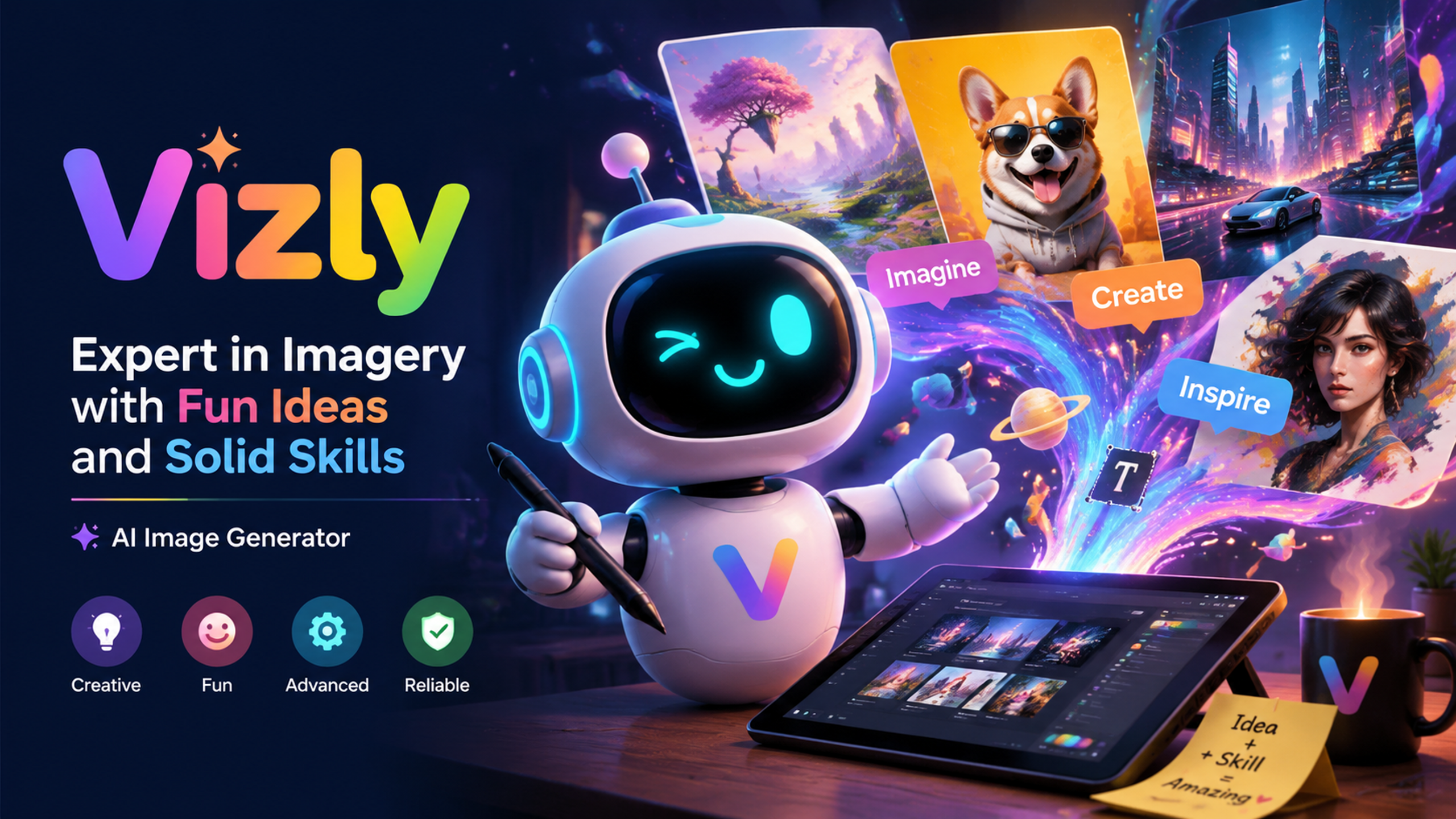
Real-world uses that actually work
I tested Vizly across three different scenarios people actually encounter:
- Quick social media visuals. Needed a background for an Instagram story about “Monday morning coffee.” Prompt: “splashes of coffee forming an abstract art, warm tones, messy but artistic.” Vizly gave me something that looked like a coffee shop’s Instagram post—usable in under a minute. No tweaking.
- Design exploration for a product mockup. I’m not a designer. I needed to show a concept for a smart water bottle. Prompt: “minimalist water bottle with digital display, placed on a wooden desk, morning sunlight.” The result had a realistic reflection and a plausible UI on the bottle screen. Enough to show my teammate without having to sketch.
- Creative experiments. Just for fun: “a dragon made of glass sitting in a library, shattered light effects.” Two out of four variations were genuinely interesting—one looked like an architectural render. That’s when I realized Vizly is more than a meme generator.
None of these required me to learn negative prompts or seed numbers. It just works with natural English.
Where it falls short (and why that matters)
Let’s be honest: Vizly isn’t the tool for hyper-detailed, photorealistic product shots where every screw thread has to be exact. If you need a technical illustration of a watch movement, you’re better off with something like Midjourney and a lot of iterations. Vizly’s strength is in concepts, atmospheres, and ideas—things that need to feel right, not just look correct.
Also, the free tier gives you a generous amount but not unlimited. For heavy batch work (say, 200 images a day), you’ll want a paid plan. That’s fine for most creators, but power users might feel the ceiling.
And one more thing: if your style is hyper-anime or ultra-specific illustration, Vizly’s default output is more cinematic and less cartoonish. It’s a bias you need to know about. You can push it toward illustration with careful prompts, but it’s not as natural as a dedicated anime model.
Is this the right generator for you?
Vizly makes most sense if you’re someone who needs to visualize an idea quickly—not a finished piece, but something that communicates a vibe, a layout, a mood. Content creators, early-stage designers, indie makers, and even hobbyists will get the most out of it. If you live in Midjourney’s Discord all day, you might not switch. But if you’ve ever felt annoyed by the gap between what you typed and what you got, Vizly closes that gap in a noticeable way.
The bottom line: Vizly is not trying to be the ultimate everything tool. It’s trying to be the one you open when you have an idea at 10 PM and want to see it before you go to sleep. And for that, it works—solidly, reliably, with a sense of what a human actually meant.
Comments
Leave a Comment